The global flavor industry is undergoing a clear shift: natural botanical raw materials are no longer just a premium marketing option, but a strategic foundation for clean-label reformulation, regulatory compliance and long supply-chain security. For flavor houses, seasoning manufacturers and food formulators, sourcing botanicals such as garlic, ginger, onion, herbs and fruit bases sustainably balances flavor consistency, farmer welfare, biodiversity protection and ESG goals.
Why Sustainable Botanical Sourcing Matters for Flavor Makers
Botanical flavor raw materials — essential oils, oleoresins, herb extracts and spice concentrates — are directly tied to agricultural cycles, weather volatility and farming practices. Climate change, inconsistent pesticide control and fragmented smallholder supply chains often create price spikes, batch-to-batch aroma variation and audit non-compliance risks.
Sustainable sourcing solves these pain points beyond “green branding”:
Stable flavor profile: Standardized harvest windows and good agricultural practices reduce fluctuation in volatile oil content, critical for garlic oil, ginger oil and spice oleoresins
Clean-label & market access: Meets FDA, HALAL, BRC requirements for natural flavor declarations
Traceability: Clear farm-to-factory visibility to answer customer audits and retailer ESG questionnaires
Lower reputational risk: Avoid issues linked to wild over-harvesting, unfair labour or restricted agrochemical residues
Long-term supply resilience: Supports regenerative farming instead of depleting wild botanical resources
Core Pillars of Responsible Sourcing for Flavor Botanicals
Cultivated-first, responsibly managed wild harvest
Priority should go to farm-grown botanicals rather than over-reliance on wild collection. Where wild-harvested materials are required, suppliers must follow verified collection limits, biodiversity monitoring and equivalent ethical wild-harvest guidelines to avoid endangering native plant populations.
Farmer partnership & fair agricultural practices
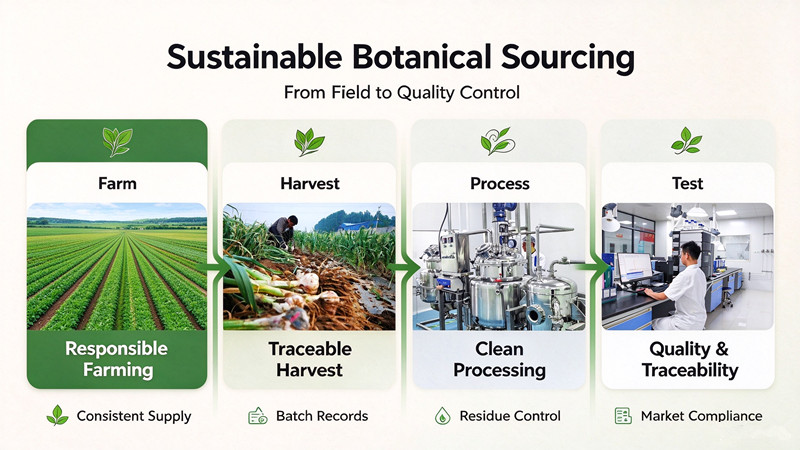
The most reliable sustainable supply chains build direct, long-term cooperation with grower cooperatives. This includes training on integrated pest management, crop rotation, water saving and residue control, plus fair payment terms for smallholders. This model delivers better consistency than spot-market buying and reduces sudden supply disruption.
Rigorous quality & residue control (without organic certification)
While we do not hold organic certifications, we enforce strict internal agricultural standards for all our botanical raw materials. Every batch goes through pesticide residue screening and heavy metal testing to align with EU and food safety regulations. Our valid qualification stack includes: BRC, FSSC22000, HALAL, Kosher. Certifications are backed by regular factory audits and batch test reports.
Low-impact extraction & manufacturing
Sustainability extends past the farm gate. Green extraction technologies including steam distillation, supercritical CO₂ extraction and closed solvent recovery cut waste, reduce energy consumption and preserve delicate flavor compounds. Wastewater treatment and by-product upcycling also lower the carbon footprint of spice oil and oleoresin production.
Common Challenges Flavor Buyers Face & How to Mitigate Them
Supply fluctuation from seasonal crops Solution: We maintain long-term planting plans with our farming partners and reserve harvest volumes in advance to minimize shortage risks.
Traceability stops at the trader level Solution: Professional suppliers who can provide batch origin records, harvest dates and farm audit reports for your key flavor botanicals.
Aroma strength differs between batches Solution: Use standardized analytical testing (GC-MS, volatile oil assay) alongside sensory evaluation to define specifications for your garlic oil, ginger oleoresin or herb extracts.

How DIELEGANCE BIOTECH Delivers Sustainable Botanical Flavor Raw Materials
We focus on traceable, farm-linked supply for natural flavor ingredients including garlic oil, ginger oil, ginger oleoresin, onion oil, botanical extracts and fruit flavor bases.
Our sustainable sourcing framework includes:
✅ Direct long-term contracts with qualified spice and herb planting bases
✅ Full batch traceability, available for customer audit
✅ Strict pesticide residue & heavy metal testing on every batch
✅ Steam distillation & low-solvent extraction for natural flavor retention
✅ Complete documentation package: COA, allergen statement, residue test, certification copies
✅ Stable MOQ and planned harvest scheduling to reduce out-of-stock risk
We serve flavor houses, seasoning factories and food manufacturers across Europe, Switzerland, Germany, Japan and North America, supporting clean-label savory, beverage and confectionery flavor development.
Final Takeaway
Sustainable botanical sourcing for flavors is an investment in consistent taste, secure supply and market readiness. Brands that build transparent, farm-aligned ingredient chains will be better positioned as regulators and consumers keep raising standards for “natural” flavor claims.
If you are reviewing your natural spice oil and botanical extract suppliers, contact us to receive origin documentation, sample specifications and sustainability statements for your formulation project.
 Kombucha Powder: The Shelf-Stable Fermented Ingredient Reshaping Functional Beverages
 Stacking Guide: Safe & Effective Ingredient Combinations for Fitness Formulations
 Key Bulk Raw Materials for Modern Sports Nutrition Formulation
 L-Glutamine Powder: Applications, Formulation Tips & Perfect Stack with Creatine Monohydrate