Introduction
Kombucha has moved from niche health stores to mainstream functional beverage aisles, with the global market projected to grow at a double-digit CAGR through the next decade . But liquid kombucha carries a fundamental limitation: it requires refrigeration, has a relatively short shelf life, and is expensive to ship.
Kombucha powder solves these problems. By removing water through spray-drying or freeze-drying, manufacturers can deliver the fermented character of kombucha in a shelf-stable, lightweight, and convenient format—without the cold chain.
This guide covers what kombucha powder is, how it‘s made, and what formulators should know before incorporating it into instant beverages, supplement blends, or functional foods.
What Is Kombucha Powder?
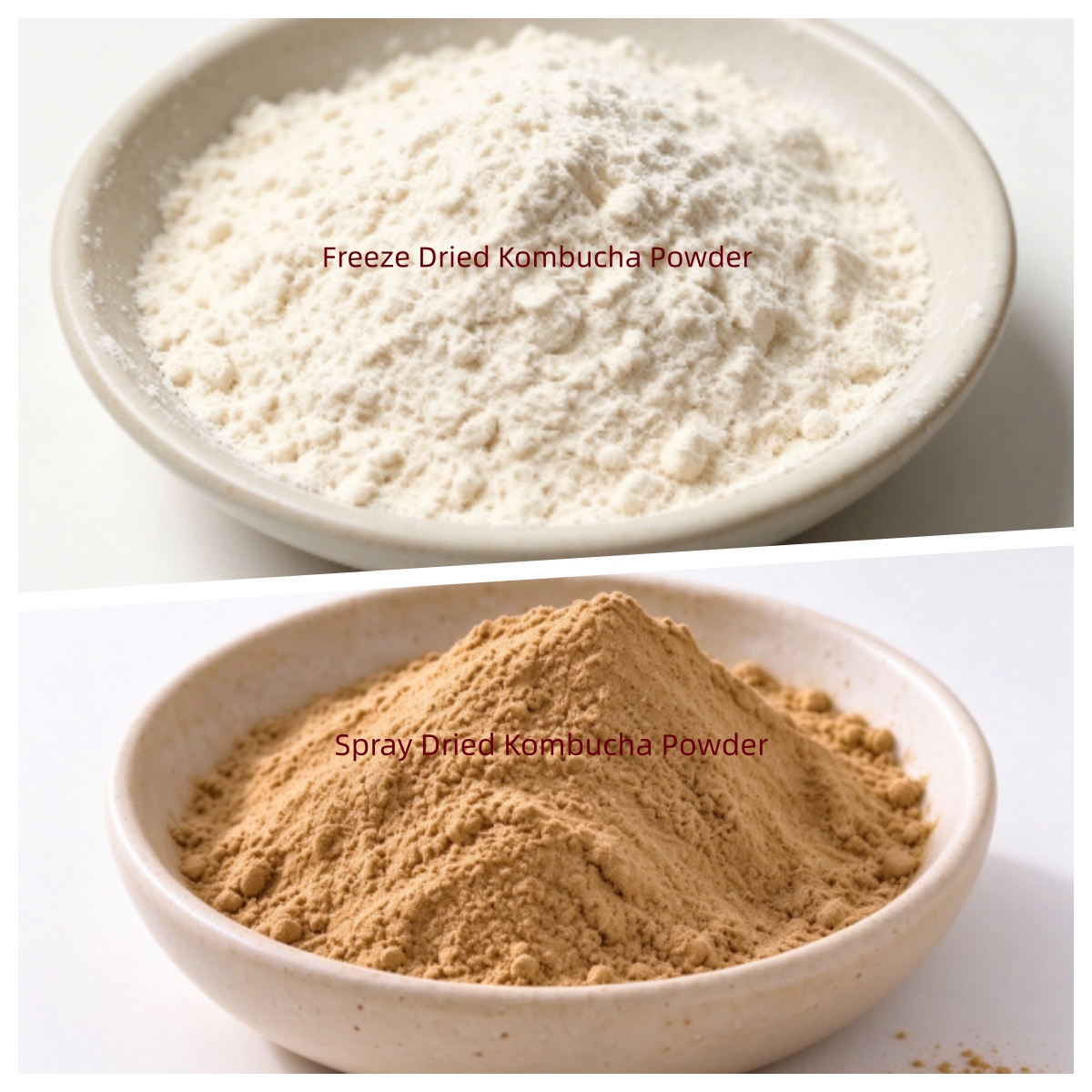
Kombucha powder is produced by fermenting tea (typically black or green tea) with a symbiotic culture of bacteria and yeast (SCOBY), then drying the fermented liquid into a powder . The fermentation process converts sugars into organic acids, probiotics, and bioactive compounds, creating the characteristic tangy profile of kombucha.
The drying step is what makes the powder commercially viable. Without it, kombucha remains a liquid product with all the logistical constraints that entails.
Spray Dried vs. Freeze Dried: What‘s the Difference?
Both methods produce shelf-stable kombucha powder, but they differ in process conditions and resulting product characteristics.
Parameter
|
Spray Dried
|
Freeze Dried
|
Process
|
Hot air atomization
|
Sublimation under vacuum
|
Heat Exposure
|
High
|
Low
|
Microbial Viability
|
Lower (heat stress)
|
Higher
|
Phenolic Content
|
Lower
|
Higher
|
Solubility
|
>90%
|
>90%
|
Moisture
|
2.22–3.62%
|
2.22–3.62%
|
Water Activity
|
0.135–0.230
|
0.135–0.230
|
A 2025 study in the Journal of Food Science compared both methods and found that freeze-drying better preserved microbial viability, while gum Arabic as a carrier effectively mitigated the thermal stress of spray-drying. For formulations where live culture preservation or maximum bioactive retention is the priority, freeze-drying is the preferred process. For cost-sensitive, high-throughput applications, spray-drying remains viable—particularly when gum Arabic is used as the carrier.
The Carrier Question: Maltodextrin vs. Gum Arabic
Neither spray-drying nor freeze-drying works well without a carrier agent. Kombucha is rich in low-molecular-weight sugars that become sticky during drying, causing wall deposition and low yields. The carrier raises the glass transition temperature, encapsulates bioactive compounds, and improves powder recovery.
Carrier
|
Key Advantage
|
Trade-off
|
Maltodextrin
|
High solubility, low cost
|
Lower encapsulation efficiency
|
Gum Arabic
|
Better emulsifying and film-forming properties; higher bioactive retention
|
Higher cost
|
Research on spray-dried kombucha found that gum Arabic at 10% achieved the highest dry yield (47.54%) and better retention of antioxidant and anti-inflammatory activity compared to maltodextrin . For premium formulations, gum Arabic is the carrier of choice. For cost-sensitive products, maltodextrin remains functional.
Applications: Where Kombucha Powder Fits
1) Instant Beverage Powders
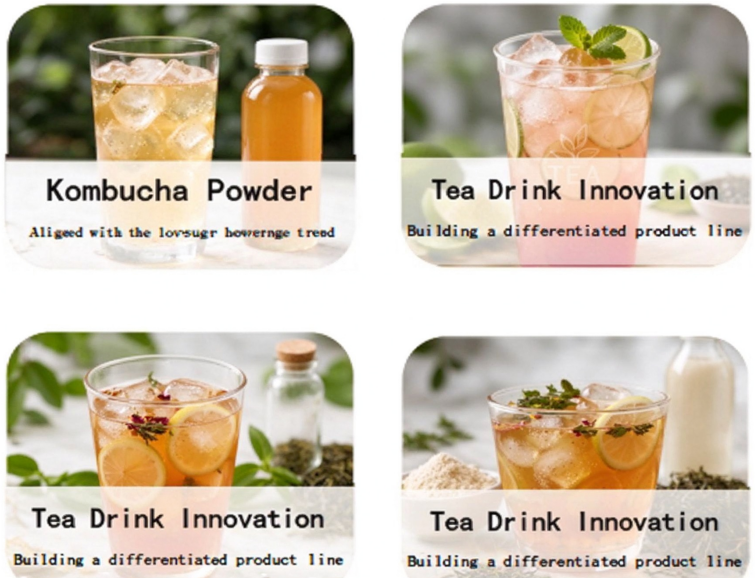
The most direct application. Kombucha powder reconstitutes in water to deliver a tangy, fermented drink without refrigeration. It‘s used in stick packs, sachets, and bulk drink mixes—formats where liquid kombucha cannot compete on convenience or shelf life.
Commercial examples like TEAZEN have sold over 400 million sticks globally, demonstrating consumer acceptance of the powder format.
2) Functional Food & Supplement Blends
Kombucha powder can be incorporated into digestive health blends, smoothie powders, and meal replacements. Its acidic profile pairs well with fruit powders, ginger, and botanical extracts.
3) Confectionery and Snack Coatings
Where a tangy fermented note is desired, kombucha powder can be used as a flavor component in coatings and seasonings.
Formulation Considerations
Solubility: Both spray-dried and freeze-dried kombucha powders achieve >90% solubility . No high-shear equipment is required for reconstitution.
Moisture and Water Activity: Typical moisture content is 2.22–3.62%, with water activity below 0.25—supporting microbiological stability without refrigeration .
Storage: Cool, dry, light-protected environment. The powder is hygroscopic and will clump if exposed to humidity.
Typical Use Level: 1–5% of finished powder blend, adjusted to desired flavor intensity.
Why Source Bulk Kombucha Powder from DIELEGANCE BIOTECH
Both drying formats available — spray-dried and freeze-dried kombucha powder, so you can choose based on your formulation priorities and cost targets.
Carrier flexibility — maltodextrin or gum Arabic, matched to your label requirements and bioactive retention goals.
Full documentation — COA, MSDS, and TDS provided with every batch, with batch-level traceability from fermentation to finished powder.
Consistent quality — controlled fermentation and drying processes, with water activity and solubility verified batch by batch.
Flexible quantities — from R&D samples to bulk production orders, with short lead times and responsive technical support.
Contact us for specifications or samples to evaluate in your instant beverage or supplement blend.
 Stacking Guide: Safe & Effective Ingredient Combinations for Fitness Formulations
 Key Bulk Raw Materials for Modern Sports Nutrition Formulation
 Sustainable Sourcing of Botanical Raw Materials for Flavor Industry
 L-Glutamine Powder: Applications, Formulation Tips & Perfect Stack with Creatine Monohydrate